

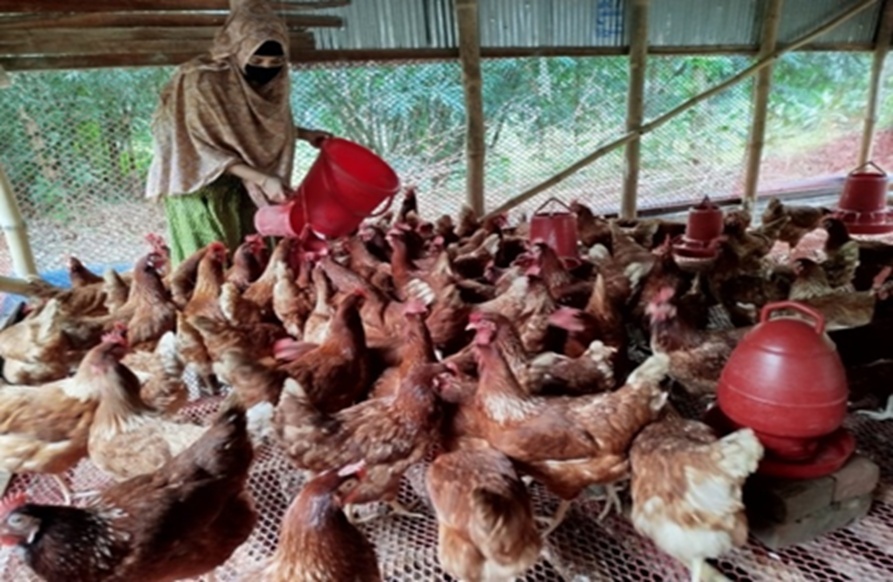

“Small initiatives, when guided by expertise, lead to sustainable prosperity,” says Afsana Khatun, a resident of Khatar village in Salikha, Magura. Once a struggling homemaker, Afsana has transformed her curiosity into a thriving poultry enterprise, securing both financial stability and nutritional health for her family.
The Challenge: Overcoming Initial Setbacks
In 2021, driven by a desire to contribute to her family’s income, Afsana began rearing indigenous (Desi) chickens. However, her lack of technical knowledge proved costly; without a proper vaccination schedule, her flock suffered from preventable diseases, leading to significant losses. Despite this setback, Afsana did not give up. As a member of the Sabek Khatar Mohila Somity under ADI, she sought a more structured approach and consulted with the organization’s Assistant Livestock Officer. Her interest soon shifted from traditional rearing to a more productive and commercial model: Layer Poultry Farming.
The Strategy: Precision in Poultry Management
In 2023, Afsana restarted her journey with a pilot batch of 100 Layer chicks. This time, she followed a rigorous management protocol guided by ADI’s technical team. Under the constant supervision of the livestock officer, she implemented proper vaccination, bio-security measures, and balanced feeding practices. Her dedication paid off, as her flock remained remarkably healthy throughout the rearing period, minimizing mortality rates and ensuring high productivity.
Impact: Economic Independence and Nutritional Well-being
Afsana’s meticulous care and adherence to scientific protocols have resulted in a highly efficient production cycle that yields significant benefits for both her household and the local community. From her current flock of 97 healthy hens, she consistently achieves a remarkable productivity rate, collecting between 91 and 93 eggs daily. This steady output allows her to meet her family’s internal nutritional needs while serving the local market demand by selling fresh eggs to neighbors and at the nearby Pulum Market. After accounting for all expenses, Afsana now earns a net monthly profit of approximately 8,000 BDT, providing her with a reliable stream of independent income. Beyond these financial gains, she has emerged as a respected figure and an inspiration in her village, actively mentoring other women to move away from traditional guesswork and embrace modern, scientific methods for sustainable poultry farming.
Afsana has proven that economic independence can start right from one’s backyard. Her journey from loss to leadership serves as a model for aspiring women entrepreneurs who wish to balance domestic life with professional success. “I have learned that knowledge is the best vaccine against failure; today, my confidence is as healthy as my flock,” she shares with a sense of immense accomplishment.