

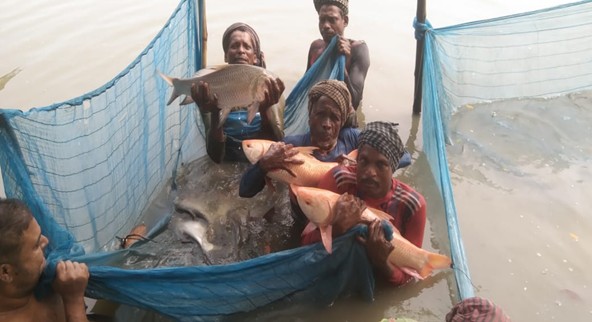

“Perspective is the key to unlocking hidden potential,” says Touhidul Islam, a rising aquaculture entrepreneur from Kalitala village, Jagdal. Facing consistent losses in traditional fish farming, Touhidul was on the verge of giving up until a shift in methodology turned his 220-decimal pond into a goldmine of productivity.
The Challenge: A Crisis of Confidence
Initially, Touhidul practiced traditional fish farming in his expansive 220-decimal pond, but the results were far from satisfactory. Frustrated by low yields and diminishing returns, he reached a point where he planned to fill the pond with soil and convert it into a paddy field. It was at this critical juncture that his wife, Sharmila—a member of the Chayabithi Para Mohila Somity under ADI—intervened and encouraged him to seek professional guidance before making a final decision.
The Intervention: Adopting the Semi-Intensive Method
Following his wife’s advice, Touhidul consulted with ADI’s Fisheries Officer and participated in a specialized 2-day training program on “Semi-Intensive Carp Fattening.” This training was a revelation. With financial and technical backing from ADI, he abandoned his plan to fill the pond and instead stocked it with 300–500 gram fingerlings of Rohu, Catla, Grass Carp, and Mrigal. To maximize the utility of his assets, he also utilized the pond embankments to grow various vegetables, including red spinach, Malabar spinach, papaya, and bitter gourd.
Impact: Record-Breaking Returns and Economic Stability
The transition from traditional to semi-intensive farming yielded financial results that far exceeded Touhidul’s expectations.
By integrating scientific fish fattening with embankment vegetable gardening, Touhidul invested a total of 477,000 BDT. His strategic approach paid off immensely when his harvest generated a gross revenue of 2,169,000 BDT, resulting in a staggering net profit of 1,692,000 BDT. Currently, his high-quality produce is in high demand across major wholesale markets in Alokdia, Jagdal, and Magura Sadar. This extraordinary success has not only secured his family’s financial future but also restored his confidence in aquaculture as a prestigious and lucrative profession.
Standing by his thriving 220-decimal pond, Touhidul feels a deep sense of peace. He is glad he chose to innovate rather than quit. “Success in farming isn’t about how much land you have, but how smartly you use it,” he remarks, looking toward a future full of possibilities.
Hi, this is a comment.
To get started with moderating, editing, and deleting comments, please visit the Comments screen in the dashboard.
Commenter avatars come from Gravatar.